


On the southern slopes of Lovćen, in the village of Mirac just ten kilometres from Kotor and the Bay of Boka, a family winery has been growing its story for years. Storia di Pietra — the name translates as "a story of stone" — is a place where exclusively organic wines are produced with care and dedication, in a setting whose geography, at 650 metres above sea level, makes it ideal for viticulture. When the time came to give this story a permanent architectural home, the client turned to Enforma with a brief that was as poetic as it was practical: build a place where wine is made and where life is celebrated.
Project
Winery with full production facilities + celebration and events hall
Project type
Conceptual and Final Design
Location
Mirac, Kotor — southern slopes of Lovćen, 650 m above sea level
Client
Storia di Pietra

A Brief Built Around Two Lives
The programme for this project was shaped by two complementary intentions. The primary function was a fully operational winery — encompassing all the spatial and technical requirements of wine production, from fermentation and barrel storage to bottling and tasting — capable of supporting the ambitions of a serious, quality-driven producer. Alongside this, the client envisioned a large multifunctional hall: a generous space for weddings, birthday celebrations, and gatherings of all kinds, where guests could experience the landscape and the wine in equal measure.
These two programmes are fundamentally different in character — one is a working, temperature-controlled, technical environment demanding darkness, mass, and thermal stability; the other is light-filled, festive, and open, oriented toward views and human warmth. The architectural task was not simply to accommodate both under one roof, but to find a form that allowed each to be fully itself while making the whole legible and coherent.
Learning from the Land
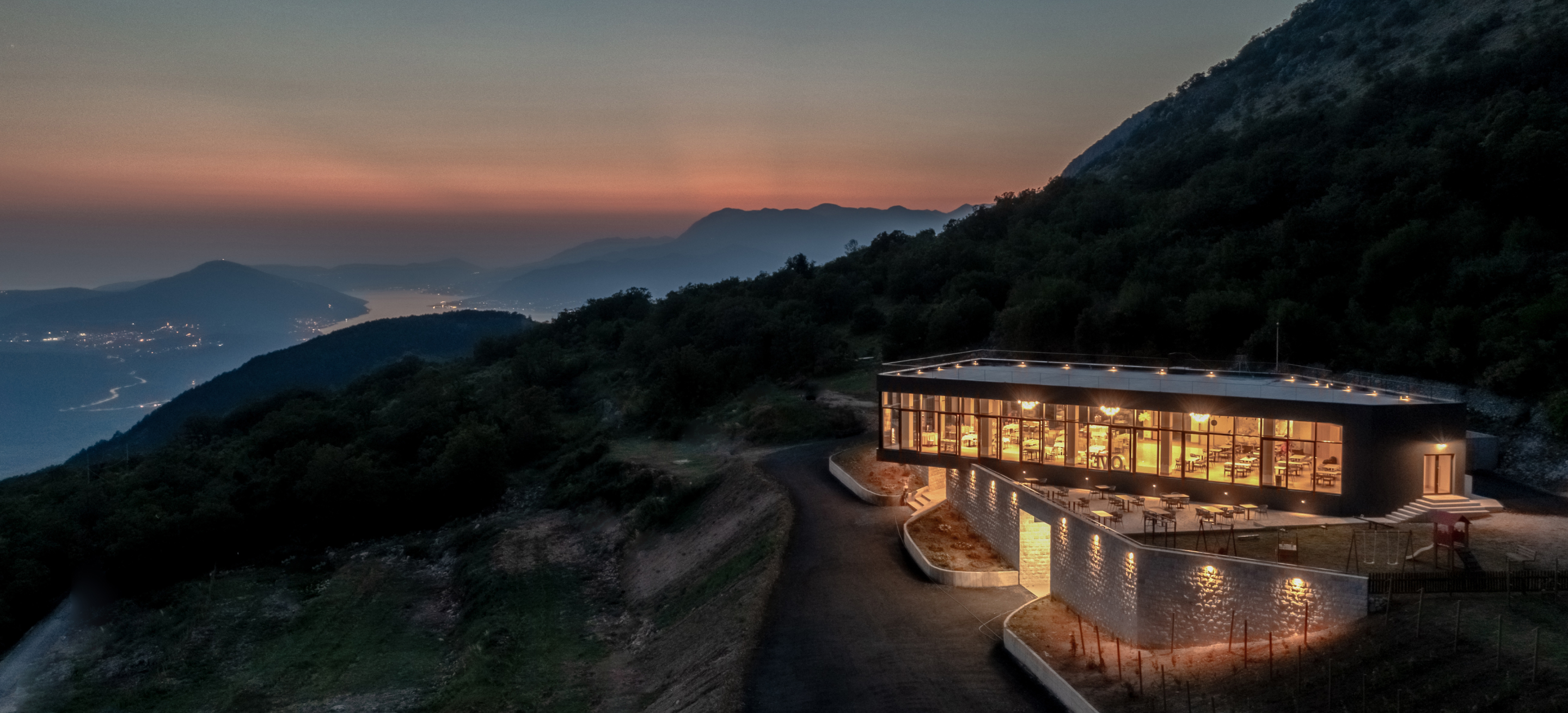
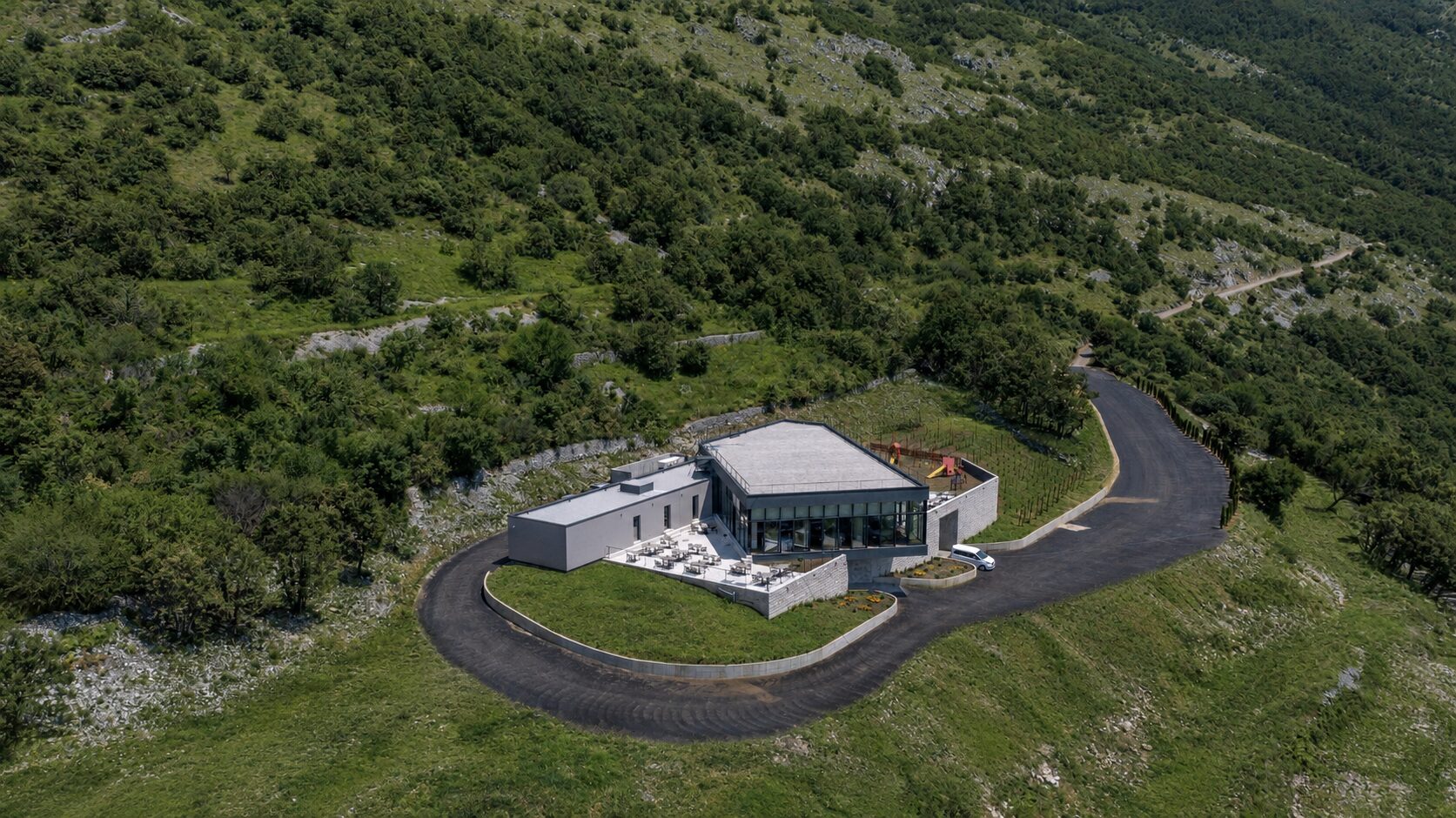
Mirac is not neutral terrain. The site sits on a steeply terraced hillside shaped over centuries by the hands of Montenegrin farmers and their characteristic dry-stone walls — the suha međa — a construction technique in which stones are carefully stacked without mortar, forming robust retaining structures that have defined the agricultural landscape of this region for generations. Any building placed here would inevitably be in conversation with this accumulated layer of human making, and Enforma's approach was to make that conversation honest and deliberate.
The guiding design principle was one of minimal visual intrusion. On a hillside of this significance and sensitivity, the question was not how the building should announce itself, but how it could belong. The answer came from the land itself.
Stone Below, Glass Above
The winery volume is conceived entirely in the spirit of the suha međa. It is built as a heavy, earthen mass of dry-stone masonry — a structure that reads as a continuation of the retaining walls already present on the slope — and is largely buried into the hillside. This partial submersion is not merely a visual gesture: embedding the production spaces into the ground provides natural thermal insulation, helping to maintain the stable, cool temperatures essential for quality wine production without excessive mechanical intervention. The building draws on the same passive logic that Montenegrin farmers applied when cutting cellars into hillsides centuries ago, now expressed through a contemporary architectural programme.
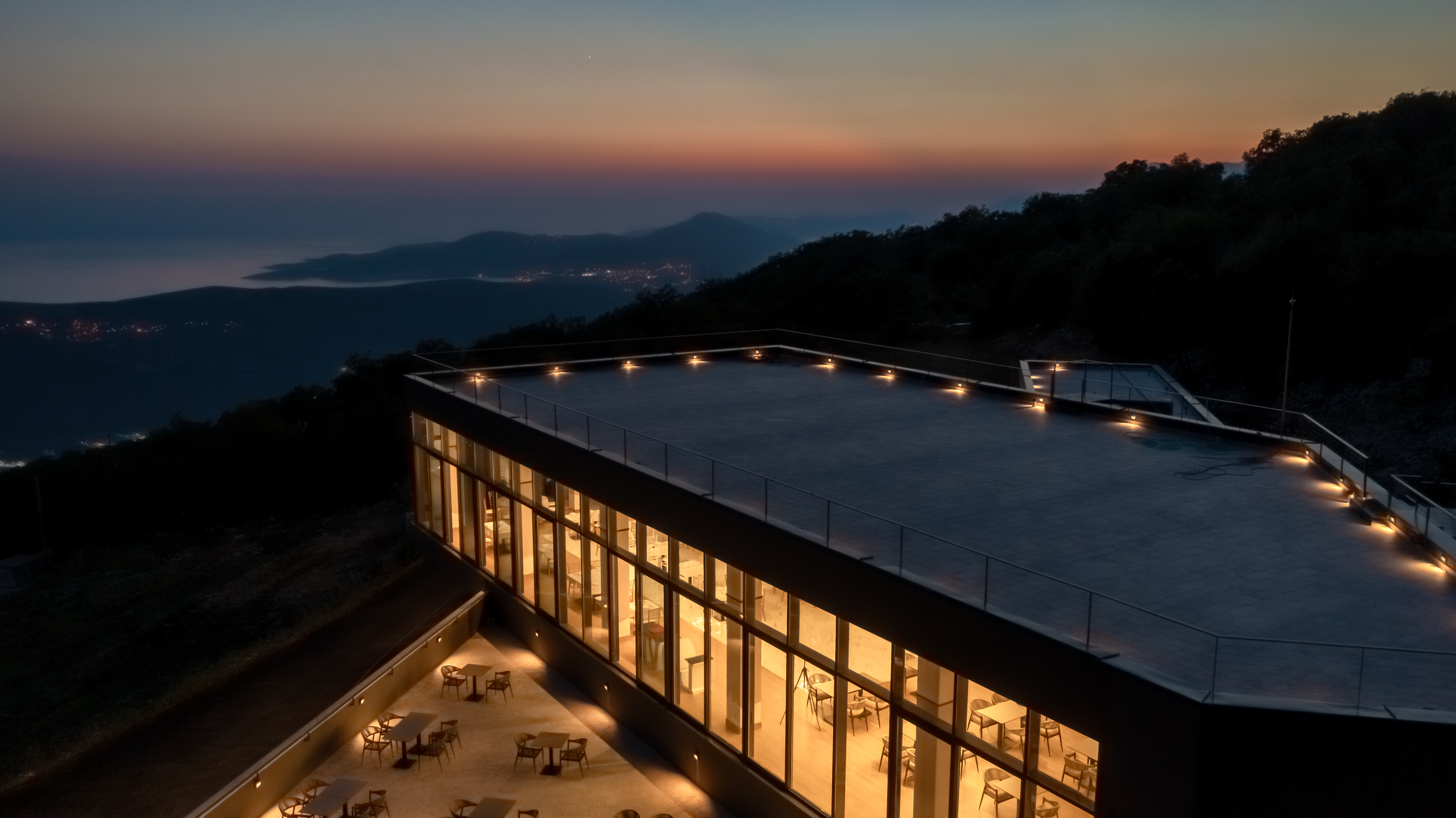
Above this stone plinth — visible, rising, transparent — sits the events hall. Conceived as a glass box, this volume floats lightly above the supporting dry-stone wall below, its lightness and transparency a deliberate counterpoint to the solidity and mass of what it rests upon. The structural relationship is clear: the ancient logic of stone provides the ground, and the contemporary gesture of glass provides the occasion. The hall's glazed envelope frames the sweeping views over the Bay of Boka and the open sea beyond, turning the landscape itself into a presence within every celebration held there.
The Dialogue at the Heart of the Project
What makes this project architecturally meaningful is the precision of its contrast. The buried winery and the elevated glass hall are not two buildings that happen to share a site — they are a single compositional idea, in which everything hidden below is in dialogue with everything revealed above. Earth and glass. Mass and lightness. Continuity with tradition and openness to the contemporary. The stone that the client has woven into their brand identity — storia di pietra, a story told in stone — becomes, in this building, not just a name but a structural and spatial reality.
Enforma's design for Storia di Pietra is an expression of what we mean by Responsive Architecture: a building that does not impose its form on a place, but draws its form from the place's deepest logic — geological, cultural, and climatic — and gives it new life.
We are grateful to the Storia di Pietra family for the trust they placed in us to shape the home their story deserves.